After Democratic sweep, Texas looms as “big kahuna” in the 2028 presidential race
Presidential nominees have long skipped Texas. But Democrats, fresh off defeating Gov. Greg Abbott and winning the U.S. Senate race, are taking a second look.
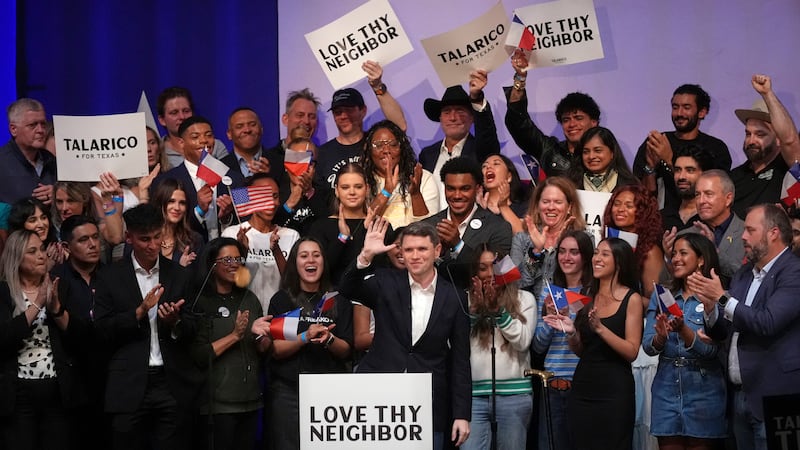
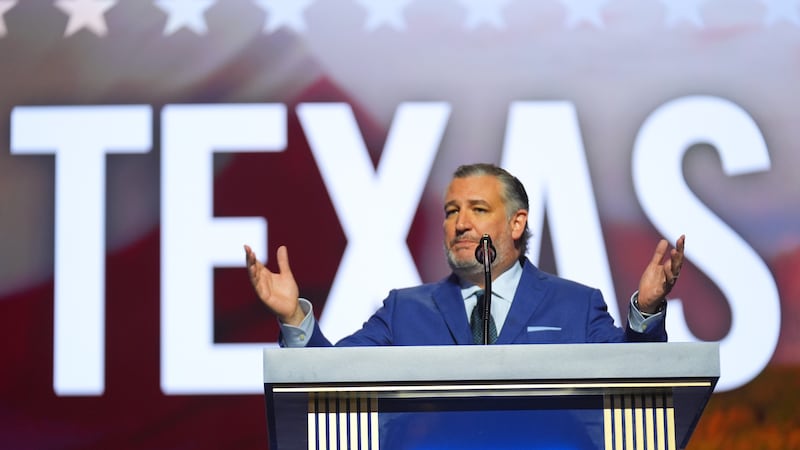
WASHINGTON — The day after Democrats swept every statewide office in Texas, Sen. Ted Cruz went on his podcast and laid down a promise.
“I give you my word: Texas will be red again,” he said.
The chair of the Democratic National Committee had a different read. Asked whether he considers Texas a battleground state in the next presidential contest, Ken Martin said in an interview, “For sure — it’s seismic.”
Just two years after President Donald Trump carried Texas by nearly 14 percentage points, Democrat Gina Hinojosa ousted Gov. Greg Abbott while James Talarico won the state’s U.S. Senate race by 12 points, showing how quickly the ground can shift here. The 2028 presidential election will be the first and most consequential test of whether that was an outlier or the beginning of a more permanent change.
At stake is a remaking of the presidential map. With 40 electoral votes, Texas is the second-biggest prize in the Electoral College and the anchor for every Republican presidential candidate since 1980. Without Texas, the path to 270 Electoral College votes is near impossible for Republicans — and after the 2030 Census, the state is poised to gain even more electors.
For decades, neither party’s presidential nominees have had to fight for it. Democrats, who last won a presidential race in Texas with Jimmy Carter, have treated the state as little more than a fundraising pit stop. In their absence, Republican candidates have won the state relatively easily and rarely showed up either.
Now the results of last week’s wave are a political Rorschach test, where prospective candidates and party figures alike see an opportunity.
Karl Rove, the architect of decades’ worth of Republican victories in Texas and George W. Bush’s chief political strategist, said Texas’ competitiveness in 2028 will turn on a few key factors that will come into focus in the coming years.
“The question is going to be, does the Republican Party get its act together by 2028?” Rove said. “And the other question is going to be, is the Democratic Party going to govern from the center, or are they going to be a bunch of Austin liberals? And then the third question is going to be, who do the respective parties nominate in 2028?”
The Democratic victory was neither a fluke nor a “dramatic overnight change in the composition of the Texas electorate,” Rove said, noting that Democratic victories were powered in part by significant crossover voting from Republicans and red-leaning independents registering their opposition to a ticket led by embattled GOP Senate nominee Ken Paxton.
Cruz, a potential presidential candidate himself, sees the results as a wake-up call for the GOP to recenter on the economy.
“We will bring Texas back,” Cruz said on his podcast the day after the election, enunciating each word. “I am filled with hope and optimism. Texas will be red again. We have not suddenly become a bunch of tofu-eating, gun-banning, tutu-wearing, pinko commie liberals. That ain’t us. Texas is still Texas. We will rebuild as a true blue-collar party — not by embracing socialism, but by being real free market conservatives.”
Martin, the DNC chair, said Democrats’ midterm sweep in Texas creates “opportunities to actually expand out the map into parts of the country that have not typically been key parts of our strategy, and now will be.” And Rove acknowledged last Tuesday’s results may bring more Democratic investment and interest into the state — and that Republicans should be ready for it.
But the amount of donor money and party attention doesn’t always translate into victories. Democrats, Rove said, had plenty of money and a significant apparatus in Texas for decades, but that didn’t stop Republican momentum.
“I was the young kid in 1980 when we were a battleground state,” Rove said of the year he served as Ronald Reagan’s Texas state director. “The Democrat apparatus was bigger and stronger than the Republican apparatus. And we won.”
How Democrats govern
For Democrats, having one of their own in the Texas governor’s mansion could unlock resources and a platform for the blue team in 2028, particularly if Democrats are able to deliver on their campaign promises using their new governing majorities both on the state and federal levels.
Hinojosa “ran for this job for one reason only, which was to help Texans,” Martin said. “But let me say selfishly, as chair of the national party, she’s going to play a huge role, because she is now governor of one of the largest states, one of the most important states. She will have a huge role in what happens in ’28.”
Texas Democrats across the board, especially Hinojosa, ran on populist platforms focused on lowering costs, boosting public education, curbing Big Tech development and eliminating government corruption. But while Democrats took control of the Texas House and governor’s mansion for the first time in decades, Republicans still hold a majority in the state Senate and are likely to throw up roadblocks limiting the sweep of Democrats’ agenda.
“Come 2027, a whole new generation of Democratic office holders will have the opportunity to show their stuff, show Texans what Democratic governance can look like in a way that helps their lives,” said Julián Castro, the former San Antonio mayor, U.S. secretary of housing and urban development and 2020 Democratic presidential candidate.
Illinois Gov. JB Pritzker, a widely anticipated 2028 contender, said in an interview that he does see Texas as a battleground moving forward, and that he expected “major investment by both parties” in the state.
“Those of us who want to see a change in the country know that Texas is the avenue through which change can occur that’ll make a big difference for the rest of the country,” he said.
Pritzker visited Texas several times this cycle and donated $1.2 million in support of Hinojosa’s bid, a level of individual support that fueled a kind of national proxy war. Numerous Latino Democrats criticized Kentucky Gov. Andy Beshear, another anticipated 2028 contender and chair of the Democratic Governors Association, for declining to invest more into her race. Pritzker, a billionaire whose family founded Hyatt hotels, also previously hosted dozens of Texas Democratic lawmakers in Illinois when they walked out of the Legislature to protest Republicans’ mid-decade redistricting scheme in 2025.
“Democrats can’t win the presidency or the Congress unless we’re winning in places that are not just blue states,” Pritzker said, pointing to Georgia’s evolution into a blue state beginning in 2020 as a “signal” that investing in GOP-controlled states in the South could pay off. “Texas is the biggest. It’s the big kahuna.”
And even the perception of competitiveness could compel Republicans to divert resources from more traditional battlegrounds to preserving their win streak in a state they cannot afford to lose.
Republicans in the state have long feared that one Democratic statewide win would trigger a flood of donor money and interest to a state most Democrats had long since written off. The 2026 sweep could open the floodgates.
Who the parties nominate
Talarico himself expressed caution against reading the 2026 results as a shift in the partisanship of the state. But he said Texas is “absolutely” on the map for the next presidential race.
“I think this shows that if candidates run in Texas who connect with Texans, who speak to their needs, who build a big tent, they can absolutely be successful in our state,” Talarico told Politico last week. “And I would urge every 2028 candidate to vigorously compete in our state.”
Such a campaign would mark a stark difference from past cycles, when presidential activity in Texas has tended to dry up after Super Tuesday.
Vice President Kamala Harris made all of one post-Labor Day campaign stop there in 2024, for an event with Houston native Beyoncé. Despite losing by less than 6 percentage points in 2020, Joe Biden never visited Texas that fall. And Hillary Clinton never visited in the 2016 general election.
Across his three runs, Trump hosted three rallies and gave one speech in 2016, and made zero general election campaign visits in 2020 or 2024. Mitt Romney in 2012 visited for a number of fundraisers but only three public events. And John McCain spent two days in Texas during the 2008 general election, delivering one speech.
Castro said it was a combination of limited resources, the presence of Texas Republicans on the ticket and unfavorable data that kept Texas off of the battleground map for decades.
Even after last week, winning the state’s 40 electoral votes remains an enormous lift for any Democrat, given its expensive nature and fundamental partisan lean. But Castro expects 2028 to be different: more candidate visits, more attention and more resources for November, not just Super Tuesday.
“I don’t think anybody expects 2028 in Texas to be as favorable as 2026 was, since 2026 was a once-in-a-lifetime wipeout for Republicans. But, I’m convinced that it’s going to be much more competitive than it has been in the past,” Castro said.
Outgoing Sen. John Cornyn contended that Republicans lost his home state largely because their brand was tarnished among key voter blocs. Texas, he said, is “still center-right and basically red except for these extraordinary circumstances.”
“I think people lost confidence in the Republicans because of their tolerance for corruption, both at the state level and at the national level,” Cornyn said. “But Democrats need to be careful, because I don’t think — Texas didn’t turn blue. This wasn’t a mandate for them, this was a referendum on the status quo. So, it’ll be fascinating to watch.”
Candidate quality, Rove noted, cuts both ways and will matter greatly for 2028.
If Republicans nominate someone who can adhere to and strengthen the party’s old school appeal — economic growth, good schools, limited government, strong national defense and traditional values among them — then Rove is confident the state will return to its Republican nature. In a Democratic field expected to be sizable, the nominee will determine if Texas is in play.
“They nominate the governor of California? That’s not going to be helpful in Texas,” Rove said. “The question is, can they nominate somebody who’s going to be a moderate, a moderate centrist Democrat, traditional Democrat. Then they might have a shot.”
Texas’ newfound blue streak will also matter for Cruz, who has teased a presidential bid in recent months and taken an occasional swipe at presumed frontrunner JD Vance. As one of the few statewide Republicans still in office, he is well-positioned to lead the party back to power.
To that end, Cruz allies launched a nonprofit called Saving Texas, headquartered in Austin, a week after the election, to focus on rebuilding the GOP’s candidate bench, infrastructure and war chest. On his podcast after the election, Cruz committed to “pouring every breath, every strength in my body” into Republicans’ comeback effort in Texas.
Texans have been on a major-party presidential ticket in eight elections since 1960. In each case, the party whose ticket included a Texan won the state — though in 1988, both tickets had one, with George H.W. Bush beating Michael Dukakis and his running mate, Texas Sen. Lloyd Bentsen.
On the other hand, Hinojosa’s win means that, if Cruz were to win the 2028 election, she would get to appoint his temporary replacement until a special election could be held. However, Cruz’s Senate seat is not up until 2030, so a loss in the Republican primaries or general election would not impact Republican control of the seat.
And Cruz is not the only Texan who could warrant presidential attention. If Texas is truly competitive, its electoral weight could convince the eventual Democratic nominee to want a Texan on the ticket, Castro said.
“I expect that both Talarico and Hinojosa will be very seriously considered as vice presidential nominees, under the theory that they can help carry Texas,” Castro said.
Copyright 2026 KWTX. All rights reserved.