Ex-Central Texas school principal’s bid for new trial stalls
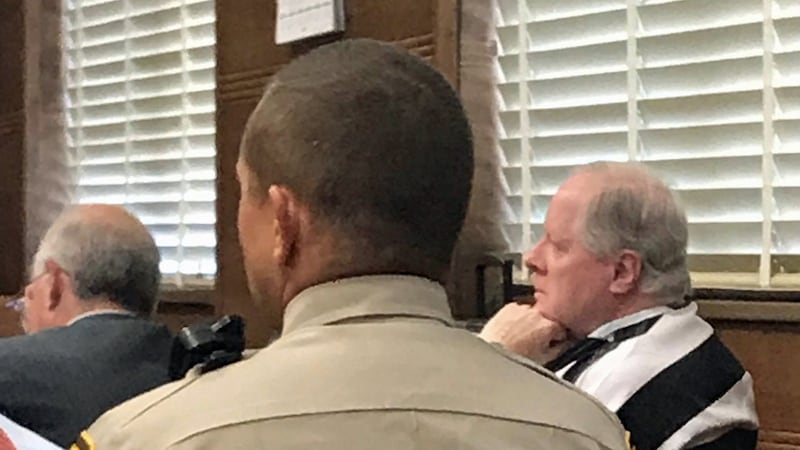
Testimony ended just after noon Wednesday in Comanche where attorneys for a former Clifton school principal convicted 33 years ago of killing his wife are asking for a new trial based on the original prosecutor’s use of “junk science.”
Bryan was convicted in 1986 of the shooting death of his wife, Mickey Bryan, who also worked at Clifton schools.
That sentence eventually was overturned but his 1989 re-trial ended with the same result – guilty of murder and a 99-year sentence.
This appeal, filed by Waco lawyers Jessica Freud and Walter “Skip” Reeves, came as a Writ of Habeas Corpus and it was that issue that the hearing surrounded.
Judge Douglas Shaver, at the end of Wednesday’s testimony, suspended the hearing and made no ruling because there is still evidence being tested that final reports have not yet been completed on.
Shaver did not set a date to continue the hearing.
At day’s end when all of the testing has been done and presented to Shaver, he’ll make a finding of facts that were presented during the three-day hearing and then can make a recommendation to the Texas Court of Criminal Appeals about whether to order a new trial.
The ultimate decision, however, rests with the state appeals court.
The issue has raised some eyebrows in Austin, as well, as Mike Ware’s the executive director of the Innocence Project made comments about the hearing recently.
“Sibley’s position is unjustified, legally and morally.
“Texans, including prosecutors, have stepped up to deal with the problem of wrongful convictions.
“The results have been impressive.
“Hopefully, Sibley will study this history and join the vast majority of Texas prosecutors who take seriously their oath to seek justice.
Waco attorney Alan Bennett began Wednesday’s testimony saying Bryan’s original attorneys provided him ineffective assistance at the appeal level.
Bennett pointed out that when Bryan was tried the first time, Mickey Bryan’s brother, Charlie Blue, sought out and hired a private Stephenville lawyer to help prosecute the case.
The district attorney, Andy McMullen, was a “one-man band” Bennett said and he needed help to prosecute this high-profile case.
The Texas Attorney General’s office provides assistance in such situations but McMullen chose not to ask them.
Bennett said Bryan’s original lawyers should have made that point in early appeals but failed to do so, and that, Bennett surmised, constituted “ineffective assistance of counsel.”
Another Waco attorney, Charles McDonald, Jr., son of one of Bryan’s original lawyers, testified later it pained him to do so, but he agreed with Bennett: “They made a mistake. It should not have been omitted,” McDonald said.
Baylor Law School criminal law professor Bryan Seer testified second and his issue was the hiring of a private attorney in this case amounts to a violation of due process.
Seer said the issue is when a private attorney is hired, he has a duty to his client, but in the Bryan case, the duty is compromised because he first must represent the clients who paid him, then he must represent the interest of the State, and those might not align.
“He (the hired prosecutor) has a conflict between being doing justice for the state and zealously representing his client,” Seer said, “He is not beholding to doing justice (for the state) but for one particular client.
“A prosecutor’s sworn duty is to seek justice, not a conviction,” Seer said.
As well, Seer talked about the basic rule of all prosecutors to “avoid the appearance of impropriety” and in this case the DA didn’t do that.
“It’s in the ballpark to say due process has been compromised and it’s not a stretch to say that,” Seer testified.
The mood in the courtroom changed somewhat when Seer, from the stand, announced that he had taught Freud and Sibley, as well as Sibley’s brother and his father when they attended Baylor Law School.
Under Sibley’s cross examination Seer pointed out the chain of custody of Bryan’s car was in question because Blue had it for five days.
Seer pointed put that the lawyer Blue hired was hired to assist McMullen, but many of the pre-trial meetings among law enforcement and the prosecutors took place at Gary Lewellen’s Stephenville office, and that, in itself, seemed inappropriate.
“I think that there is a strong argument that the relationship (between McMullen and Lewellen) had an effect on the outcome of this trial,” Seer said.
But Seer also said when one takes all the evidence as a whole and discounts what was questionable, “there is a real question about whether Mr. Bryan should have been tried in the first place.”
There has been some question about Blue’s involvement in the case, since for five days after Mickey Bryan’s murder, he had custody and control of Joe Bryan’s car.
It was in that car, in the presence of Lewellen, that the blood-spattered flashlight was discovered.
“Everything about this case is weird,” Seer said, “Mr. Blue’s unfettered access to the car where the flashlight was found six days later and his hiring of a special prosecutor even before the DA asked for help.”
Seer also took issue with the prosecution’s refusal to consider that an intruder might have committed the crime.
Sibley said the murder weapon was the same one Bryan owned and kept in the house and it didn’t make sense that an intruder used it.
The trial record shows the murder weapon never was recovered so outside the weapon being a .357-magnum, nobody knows anything about it.
“The crime scene is more consistent with an intruder (being the killer) because it was on the bedside table and he found it,” Seer said.
Seer other issue was the absolute lack of evidence as it goes to motive.
“There was no record of domestic abuse, there was no financial insecurity or no evidence of an extra-marital affair and having those things lacking is weird,” Seer said.
“I have a really hard time determining that was no reasonable doubt,” Serr said, but “jurors, as hard as they try, are all rookies.”
The Texas Ranger who investigated a Clifton teacher’s death 33 years ago testified in her husband’s court hearing Tuesday as Joe Bryan seeks a new trial.
Bryan, the former principal of Clifton High School, has spent three decades in state prison, but is seeking a new trial after experts determined that key blood spatter evidence used to convict him of killing his wife was flawed.
Retired Texas Ranger Joe Wiley testified he and other investigators could find no obvious sign of forced entry at the home on 918 South Ave. O in Clifton where Mickey Bryan’s school principal found her body on Oct. 15, 1985
Wiley would later testify in Joe Bryan’s murder trial that her killer either “used a key, found an open door or was let into” the home on the night Mickey was shot to death.
Wiley testified Tuesday that while he and others were processing the scene that day, at about 6 p.m. the bedside alarm clock rang, which Wiley said meant it had not been turned off that morning.
Wiley’s testimony followed that from the man who sent Bryan to prison in the first place, former 220th District Attorney Andy McMullen.
Bryan’s attorney Jessica Freud asked McMullen Tuesday about how a prosecutor uses blood spatter analysis to solve a crime and McMullen said it was a learning experience for him because “I’d never heard of blood spatter evidence analysis before this case.”
Midway through Wiley’s testimony the focus somewhat changed from pointing out Bryan’s innocence to identifying who the real killer might be.
“Just a few months before the (Mickey Bryan) murder there was another one, a young girl, who was killed on the far west side of town,” Wiley said.
Judy Whitley, 17, “was found on the far west side of the city, but in the city limits, on the west side of the hospital,” Wiley said.
She’d been reported missing and within hours most of the town turned out to search for her, Wiley remembered.
“She was found naked, except for her socks, face down with her arms stretched above her head and her wrists crossed,” Wiley testified.
Wiley said he believes Mickey Bryan and Whitley were killed by the same person.
Rumors in town at the time pointed to a Clifton poIice officer as a possible suspect and Wiley said he interviewed Dennis Murray Dunlap about the Whitley killing.
“I interviewed him because there were lots of rumors and several complaints were filed about him stalking women,” Wiley said.
The Ranger had Dunlap do a polygraph test at the Department of Public Safety lab in Waco but the results, Wiley testified, were inconclusive.
Wiley was able to find some questionable issues in Dunlap’s background.
He was fired from a police department after reports of fondling surfaced, he was the subject of an FBI investigation and had been accused of providing marijuana to teenage girls in exchange for sexual favors, Wiley testified.
He was never arrested in connection with any of those issues, Wiley said.
Clifton police Chief Trace Hendricks took the stand next.
He was a cadet at the Clifton Police Department while Dunlap still was working there but he testified he had only limited contact with him.
The ex-wife of the man who was the Clifton ISD’s superintendent while Bryan was there said emphatically from the stand Tuesday that there is no way Bryan killed his wife.
Linda Lairdon, a Clifton real estate broker, said she, her former husband and the Bryan’s were fast friends and very active together.
“Joe is innocent,” she said from the stand.
She recalled how former Clifton police Chief Rob Brennan surprised her at her Clifton office a few days after the murder and said the chief was rude, forceful and already had decided what he wanted to know.
“He tried to get me to discredit Joe, tried to get me to say he was gay and he was railroading Joe from the very beginning,” she said.
She also testified about encountering Dunlap before she even knew who she was.
She said she encountered a man at the Dairy Queen one day who made unwanted advances toward her and acted very inappropriately as she was buying lunch for her little league team.
Her 11-year-old son was there, as well.
“I can’t describe the feeling I had, but it was very unsettling, very creepy,” Lairdon said.
She stared to recount another story but Freud stopped her, suggesting it might be hearsay.
After she was released from testifying, outside the courtroom, she said just weeks ago she and her son were talking by telephone and he remembered the Dairy Queen incident and said it scared him.
Testimony is set to continue Wednesday morning but lawyers say they’ll wrap up tomorrow.
A hearing is underway in Comanche in which attorneys are challenging key evidence in the 1985 conviction of a former Clifton High School principal accused of killing his wife, a popular local teacher
Attorneys Jessica Freud and Walter “Skip” Reaves, represent Bryan in his bid for a new trial 33 years after the shooting death of his wife, Mickey, 44.
Dr. Tom Bevel, a world-class forensic scientist known for his expertise in blood spatter analysis, testified Monday afternoon that the evidence used to convict Bryan of his wife’s murder in 1985 was inaccurate.
Bevel was the second expert who testified Monday and both had the same opinion, which was that science that was used to convict Bryan in 1986 was “junk science” and could not stand the scrutiny of testing today.
Bryan fought back tears as he sat in the courtroom while Bevel reviewed a series of crime scene photographs and based on the photos was able to determine just how the original investigator organized the scene and was able to point out errors in the investigators methodology.
“He (the original investigator) doesn’t understand how to do this in a number of areas,” Bevel testified.
Bevel was the second forensic scientist to cast doubt on the original evidence used to convict Bryan in both 1986 and his re-trial in 1989 was not accurate.
A Montgomery County forensic scientist testified Monday morning evidence used in 1986 to convict Bryan of his wife's murder was insufficient.
Celestina Rossi told Judge Douglas Shaver the blood spatter evidence used to convict Bryan of the 1985 murder of his wife could not stand the scrutiny of modern lab testing and could not have been used to convict Bryan.
Bosque County District Attorney Adam Sibley explained at the beginning of the hearing that the state had not yet received results from laboratories that still are re-testing evidence used to convict Bryan.
“Why not,” Shaver asked
“It’s just not finished yet,” Sibley said.
Freud called Rossi to the stand and began her questioning by establishing Rossi’s background as an expert in the field.
Rossi, one of at least four witnesses Freud and Reaves planned to call, began dismantling the forensic science issues used to convict Bryan piece-by-piece.
Rossi pointed out that the investigator who presented the evidence at trial had only the basic education in blood spatter analysis and, according to his records, had never completed any additional training.
The FBI, which monitors all scientific testing issues in the country, she testified, says a blood spatter analyst must complete continuing education on a regular basis and the original investigators “shows no evidence of additional education."
As well, Rossi said, conclusions reached in investigator Robert Thorman’s report may be invalid because they likely were improperly measured when collected.
A caliper or other critical measurement device should be used, but in the Bryan case Thorman used a yardstick.
“That kind of measurement cannot give the investigator critical enough measurements to be meaningful,” she said.
“Thorman’s testimony was inappropriate and was not supported by testing,” Rossi said.
Given the inaccuracy of the measuring devices used in the Bryan case, a supportable conclusion couldn’t be drawn and Thorman’s statement in court was “probably just a guess,” Rossi said.
The other issue Rossi spoke to was the number of blood spatter stains tested and eventually entered into evidence.
She said Thorman collected only five samples, which she said was not nearly enough to arrive at the conclusions Thorman testified to.
There were four gunshot wounds in Mickey Bryan’s body and Thorman collected only five samples when there should have been a bunch, Rossi said.
This was “not a correct methodology, he should have collected many, many more,” Rossi testified.
“It was a complex scene with a lot of surfaces that should have been more properly investigated,” Rossi concluded.
Thorman also issued a conclusion about where the killer was standing and how high he held the gun when he fired it, what forensic scientists call the “area of emergence,” but, Rossi said, the data that Thorman presented in his report were not sufficient to reach that conclusion.
Thorman testified the gun used to kill Mickey Bryan was fired by someone the same size as Joe Bryan, but Rossi said the data that Thorman used to support that claim were not sufficient to make that determination.
“An area of emergence can be determined, but the data presented here is not the data that is required to establish that,” Rossi said.
“I don’t think I could determine anything from this data,” Rossi said.
“It was simply improperly assembled.”
Freud told Judge Shaver at the outset she does not anticipate being finished until Wednesday.
Bryan currently is in custody at the Huntsville Unit, in Huntsville, has a projected release date of April 17, 2025.
He has been eligible for parole since July 2007, TDCJ-ID inmate records show.
Reaves and Freud are presenting evidence gleaned from a Texas Forensic Science Commission report that was released in July that says the science used to convict Bryan was "junk science" and was totally unreliable.
"In incredibly brief summary, the commission concluded that nearly all the scientific evidence used to convict Joe - and there was never much to begin with - was, and is, either flat out wrong, unreliable or scientifically unsupportable," Freud said at the time.
Blood spatter on a flashlight lens turned out to be Bryan's coffin nail when in 1986 an expert testified what the tiny red dots on the clear plastic lens were and how they got there.
A surprising analysis of the blood spatter on the lens revealed that what prosecutors in 1985 said was proof Bryan held his flashlight in one hand and his .357 magnum in the other when he shot his wife, may not have been blood, at all.
"Basically, the commission found the bloodstain pattern analysis used in Mr. Bryan's case is not scientifically supportable under standards in effect at the time or under today's standards," TFSC board secretary Kathryn Adams, said in the report.
TFC's report went on to say a primary issue revolves around "the presence of blood on a flashlight" and the laboratory at "DPS Waco is currently working on DNA testing and may be able to shed some light on that question."
Reaves, in a story on Bryan's appeal published June 12 on KWTX.com, said "without doubt, there is less evidence in this case than any other one I've dealt with over 35 years and on a scale of 1-to-10 the evidence presented in Bryan's trials was a 1, seriously lacking."
Bryan has maintained unfailingly since his arrest he did not do it and was actually innocent of the crime, not just "not guilty".
On July 12 the Texas Board of Paroles and Paroles announced members had denied Bryan's fourth request for release, in spite of prison officials saying time and time again that he is a model inmate, has no disciplinary actions and plays piano at the prison chapel services.
Some say the board passed over his requests because he refused to accept responsibility for his wife's murder.
Says Reaves, "Maybe that's because he didn't do it."
Bryan, at the time of his wife's murder, was checked in at the Hyatt Regency Hotel, in Austin, preparing to attend a meeting of the Texas Association of Secondary School Principals, set for 8 a.m. the next day.
In his first murder trial, prosecutors told the jury that between 9:15 p.m. on Oct. 14, 1985 when the two spoke by telephone, and sunup the next morning, when Mickey was found shot to death, Bryan slipped out of his Austin hotel unseen, drove 120 miles to Clifton in the dark and through a heavy rain storm, with an eye condition that made it nearly impossible for him to drive at night, shot his wife, in spite of the fact there was no history of conflict between them; drove 120 miles back to Austin; went back to the hotel and stole upstairs to his room with plenty of time left over to shower and clean up so he could make his 8 a.m. meeting.
All of that without leaving a single witness at any one of those places or any type of forensic evidence anywhere.
Testimony in trial showed Mickey Bryan had been shot three times in the head and once in the abdomen at very close range, her report of autopsy showed.
Medical examiner Dr, Graeme Dowling, who completed the post-mortem examination, reported finding the gunshot wounds in her head and body.
The room was covered in blood and the coroner told investigators the incident would have left the gunman extremely bloody as well.
Yet no bloody clothes or shoes were found at the crime scene or anywhere associated with Bryan.
A pair of Bryan's underwear were found in a trashcan at the Clifton home, still damp, that tested positive for semen deposited by a Type A secretor, which Bryan also is.
The fatal wounds, prosecutors said, had been caused by rounds fired from a .357-magnum caliber weapon, but no trace of the handgun ever was found and it was not present at either trial.
Bryan had told investigators he owned a .357-magnum that he kept next to the bed, loaded with snake shot because there were snakes around where the couple lived.
That handgun, and some jewelry were missing from the couple's home.
Forensic tests provided McMillen with enough evidence during trial that he said the gun used was a .357-magnum pistol and that was never challenged, Reaves said.
But the murder weapon, itself, never was recovered, nor was the jewelry.
At trial McMullen explained the missing items away by saying Bryan would have discarded them to prevent them becoming part of the investigation.
Bryan was found guilty and sentenced to 99-years in state prison.
Reaves and Freud are representing Bryan on appeal, largely based upon the fact that the science used to convict Bryan in 1985 and in 1989 was imprecise and extremely fallible, a point which hasn't been brought up in Bryan's appeals process before.
Reaves believes, and that belief is supported by new science, that the blood spatter evidence protocol used to convict Bryan was based on what today is "junk science".
A major link in the conviction came after McMullen introduced the blood spatter that was found on the lens of a flashlight inside Bryan's car trunk, and that evidence was, in large part, responsible for the conviction.
But it's that very blood spatter evidence that Reaves is calling into question today and that blood spatter evidence that might in the end lead to Bryan's release.
Freud got involved almost five years ago in the Bryan case when she was still at Baylor Law School and was interning for Reaves, she said.
It was her research that guided the appeal issues set for hearing in August, according to Reaves.
Freud said she is so passionate about Bryan's case because: "If an injustice can happen to Joe Bryan, it could happen to any of us," Freud said.
“It happened then and it can happen today."
Convinced of an improper verdict in Bryan's case, New York Times Magazine writer Pamela Colloff, who heard about the blood spatter issue, signed up to take the forensic blood spatter evidence course and later wrote an article about Bryan's case.
Coloff was in the Comanche County courtroom on Monday.
Just four short months before Mickey Bryan was killed, the body of a Clifton teenager, Judy Whitley, 17, was found in a cedar thicket near the city's Goodall-Witcher hospital.
Before these two murders, people in Clifton couldn't say when they remembered the last one happened.
Whitley had been brutalized and she was found lying naked, in a cedar woods on the far west side of town.
No one's ever been arrested for her murder.
But the former editor and owner of the Clifton Record newspaper, who has written about both the Bryan and the Whitley cases since the murders were reported, says he, and many others, believe the two murders are connected.
At the time of Whitley's murder, one of the primary suspects was a Clifton police officer, but there never was an internal investigation and he moved to another job in 1985.
Officers from the Rosenburg police force, in South Texas, responding to a call for help min 1996, found Dennis Dunlap hanging in his garage.
Subsequent investigation showed Dunlap, 49 when he died, left a note in his bedroom that day saying he'd been a suspect in Whitley's death and Rosenberg police notified Clifton police of his suicide.
Not until after his suicide did law enforcement begin an investigation into his relationship with Whitley.
Former newspaper editor Leon Smith told Colloff he later would learn from an officer who worked with Dunlap that at the time of Whitley's murder he had strongly suspected Dunlap in her death, but after the suspected officer left the Clifton Police Department, the investigation languished.
The late Clifton police Chief Jim Vanderhoof, a different chief from the man who oversaw the initial investigation, declared the case had been solved after associates of Dunlap told him the former officer had confided intimate details of the crime to them; those which likely no one but the killer would have known.
Dunlap reportedly told another police he was relieved at the time because investigators failed to find a roll of duct tape in the trunk of his car, the same kind of tape used to bind Whitley's body.
Also, police learned of a long history of Dunlap's violence against women … one victim told police Dunlap had threatened to choke her if she refused to have sex with him.
One of Dunlap's ex-wives told investigators he had bragged about having an affair with Mickey Bryan.
"All he told me was he dated her," the ex-wife, who asked not to be identified, said.
"He told me he dropped her off at her house that night, or that evening and she had told him she was going to break it off," she said.